The best STEM toys for preschoolers on a budget are open-ended and build one clear skill: blocks for engineering, linking cubes for early math, a magnifying glass for science, and pattern puzzles for logic. Each pick below sits in a spend tier, so you can go straight to the one that fits.
Prices change by retailer and by week, so this guide gives spend tiers instead of dollar figures. Check the current price on any item before you buy. The tiers work like this:
- Low spend: single items, household materials, and simple sets with one job.
- Middle spend: larger sets in one material, or toys with several parts that work together.
- Higher spend: big multi-piece sets built to be added to and used for years.
Everything here suits ages 3 to 5. If you are shopping for the whole age range, a toy that works at 3 and still holds attention at 5 is better value than one aimed at a single birthday.
Which STEM toy should you buy first for each skill?
Buy one open-ended toy for the skill you most want to build, then add a second only after the first has been used for a few weeks. The table gives a first buy for each skill at each spend tier.
Skill | Low spend | Middle spend | Higher spend |
|---|---|---|---|
Engineering | Cardboard boxes, tape and cardboard tubes | Large interlocking bricks or a chunky ramp and ball set | A big set of wooden unit blocks or magnetic building tiles |
Early math | Dice, a deck of cards and a tape measure | Linking cubes with pattern cards | A pan balance with weights and a set of counting and sorting trays |
Science | A magnifying glass and a few large magnets | A bug viewer or a water play set with funnels and cups | A child-sized microscope or a larger outdoor discovery kit |
Logic | Sequencing cards and a simple matching puzzle | A set of pattern puzzles or a cooperative board game | A screen-free floor robot or path-building coding set |
If you can only buy one thing, blocks cover the most ground. They build engineering skills directly, and children use them for counting, sorting and pattern work without being told to.
The sections below give the reasoning for each pick, so you can swap one out if it does not suit your child.
What are the best building and engineering toys for preschoolers?
The best engineering toys for ages 3 to 5 are blocks and bricks, because building and knocking down a structure teaches balance, support and cause and effect. Engineering at this age means testing what holds up and what falls over, and any toy that lets a child try again immediately does that job.
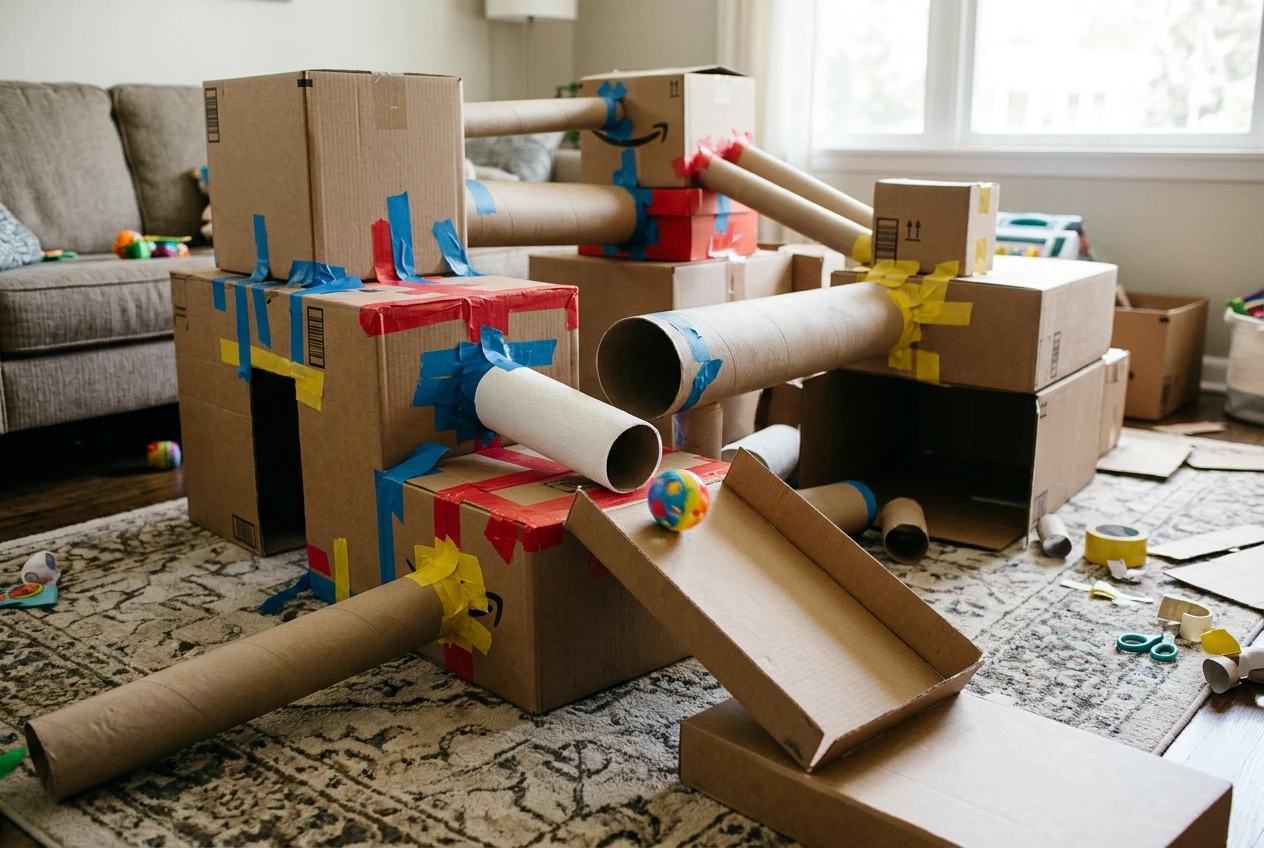
Low spend: boxes, tubes and tape
Cardboard boxes, paper towel tubes and masking tape cost close to nothing and give a preschooler real design problems: how to make a tunnel, how to join two boxes, how to stop a tower from tipping. Tape is the key part. It lets a child attach pieces, which a stack of loose blocks does not.
Middle spend: large interlocking bricks and ramp sets
Large interlocking bricks suit this age because the pieces are easy to press together and pull apart for small hands. They also lock, so a child can build something tall or wide that does not collapse when bumped. That lets them work on a plan rather than just balancing pieces.
Chunky ramp and ball sets add a different lesson. A child changes the slope and sees the ball roll faster or slower, which is an early experiment in cause and effect. Pick a set with few, large pieces. Sets with many tiny connectors tend to end up in a box once one piece goes missing.
Higher spend: wooden unit blocks and magnetic tiles
A large set of plain wooden unit blocks is one of the longest-lasting toys you can buy. The blocks come in proportional sizes, so two small ones match one larger one, which builds an intuitive sense of fractions and symmetry. A big set matters: a child can only build a bridge or an enclosure if there are enough blocks to finish it.
Magnetic building tiles let children make large, stable shapes quickly, including three-dimensional ones. Keep small magnets and any loose magnet pieces away from children who still put things in their mouths, and check the age rating on any set before you buy. If a younger sibling shares the playroom, put magnetic sets out of reach during their play.
For younger siblings who are still at the stacking stage, the best stacking toys for toddlers cover cups, stackers and soft blocks that suit that age.
Which toys build early math and pattern skills?
Toys that build early math for preschoolers are the ones that make a child count, sort, compare and repeat a pattern with real objects. Written numbers matter less at this age than handling quantities, so look for toys with pieces that can be grouped and lined up.
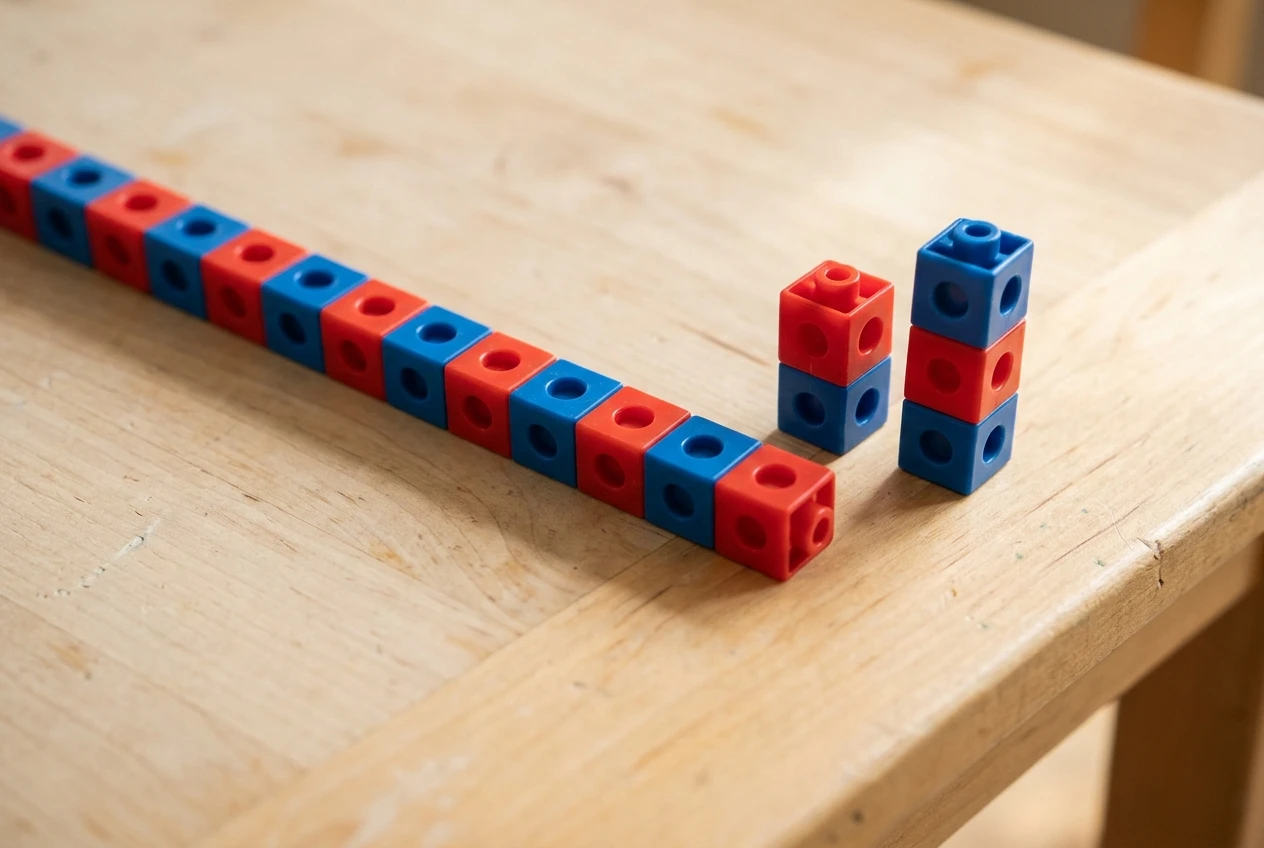
Low spend: dice, cards and a tape measure
A pair of dice, a deck of playing cards with the face cards removed, and a tape measure cover a surprising amount of early math. Rolling a die and moving that many spaces teaches counting and one-to-one matching. Sorting cards by number or suit teaches comparison. A tape measure lets a child find out which of two things is longer, which is a first lesson in measurement.
Middle spend: linking cubes with pattern cards
Linking cubes are probably the most flexible math toy at this price. A child can build a tower of five, break it into a tower of two and a tower of three, and see that the total did not change. Pattern cards add a clear task: copy the red, blue, red, blue line, then continue it. Patterns are the groundwork for later algebra, and a three-year-old can start with two colors and move to three colors as they get confident.
Choose cubes that snap together with a firm click. Cubes that come apart on their own frustrate children more than they teach them.
Higher spend: a pan balance and sorting trays
A simple pan balance with weights lets a child discover heavier and lighter by watching the pans tip. It also introduces equality: when the pans level, the two sides are equal. Sorting trays with counters give a structured place to group objects by color, shape or number, which is the first step toward sets and categories.
A balance is worth buying only if your child will use it for more than weighing one item. Put a basket of small objects beside it and let the child test guesses before checking.
What are the best science and discovery toys for ages 3 to 5?
The best science toys for ages 3 to 5 let a child observe something closely, make a guess and check it. A preschooler does not need a kit with a printed experiment sheet. A single tool that invites looking and testing does more.
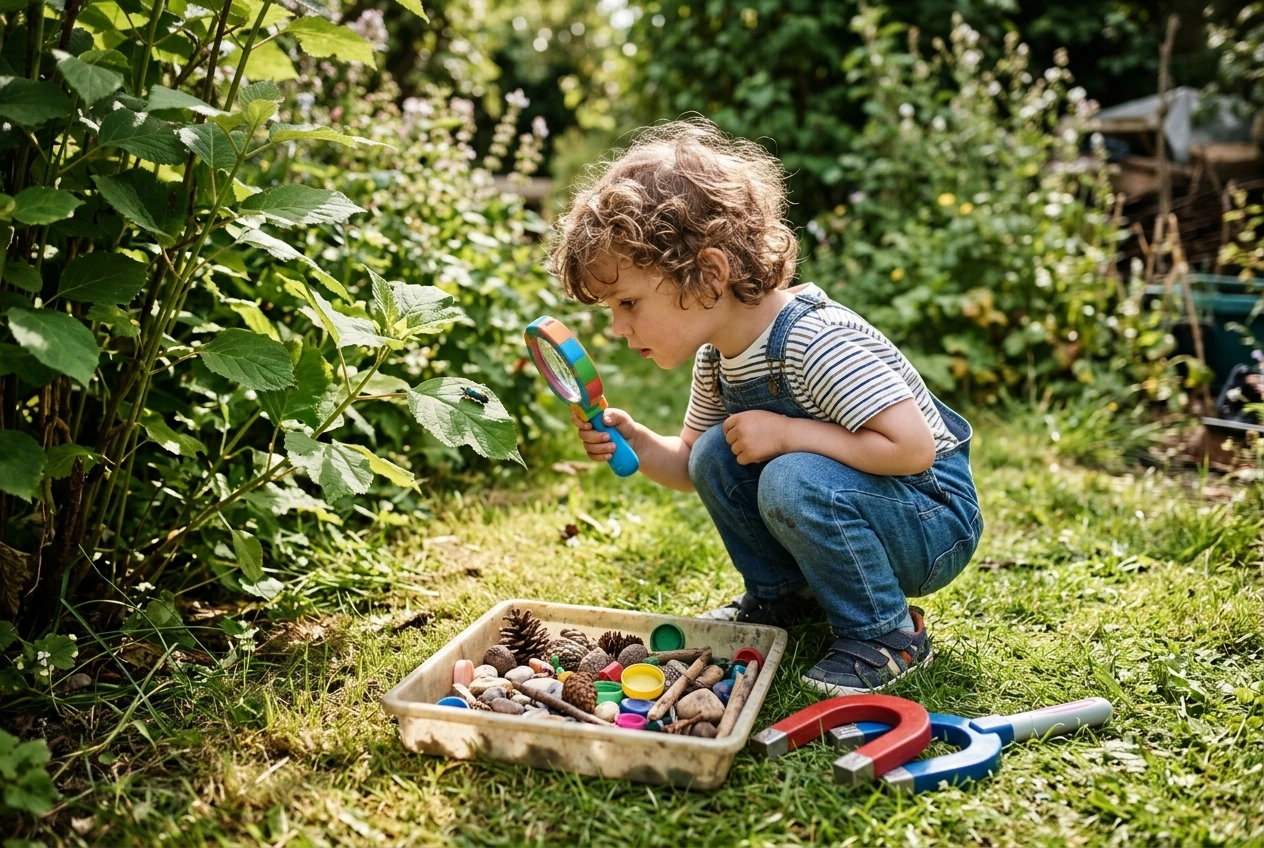
Low spend: a magnifying glass and large magnets
A sturdy magnifying glass turns a walk in the yard into an investigation of leaves, bark, insects and fabric. Pair it with a few large magnets and a tray of mixed objects, and a child can sort things into those that stick and those that do not. That is a real classification experiment, and a child can run it alone.
Use large magnets only, sized so they cannot be swallowed.
Middle spend: a bug viewer or a water play set
A bug viewer is a clear container with a built-in magnifier, so a child can look at a beetle or a snail without handling it. It encourages careful watching and gentle handling, and the specimen can be released after a few minutes.
Water play sets with funnels, cups, tubes and a few floating and sinking objects teach volume, flow and buoyancy. A child can find out which items sink and which float, then guess before dropping each new one in. If you want a bigger setup, our guide to water tables for toddlers covers the options, though a washing-up bowl and a towel also work.
Higher spend: a child-sized microscope
A basic child-sized microscope is the splurge pick for a child who already loves looking closely. It shows hair, salt crystals, fabric threads and leaf surfaces in far more detail than a hand lens. Choose one with a stable base and a simple focus control, and be ready to help with the first few slides. A preschooler will need an adult to set up each sample.
For tactile science play with texture and materials, our comparison of sensory bins vs tactile toys can help you decide which suits your child.
Which screen-free logic and coding toys work for preschoolers?
The screen-free logic toys that work for preschoolers are the ones that ask a child to put things in order and predict what happens next. Early coding at this age is about sequences: do this, then this, then this. A child can learn that with cards and a floor path before ever touching a screen.
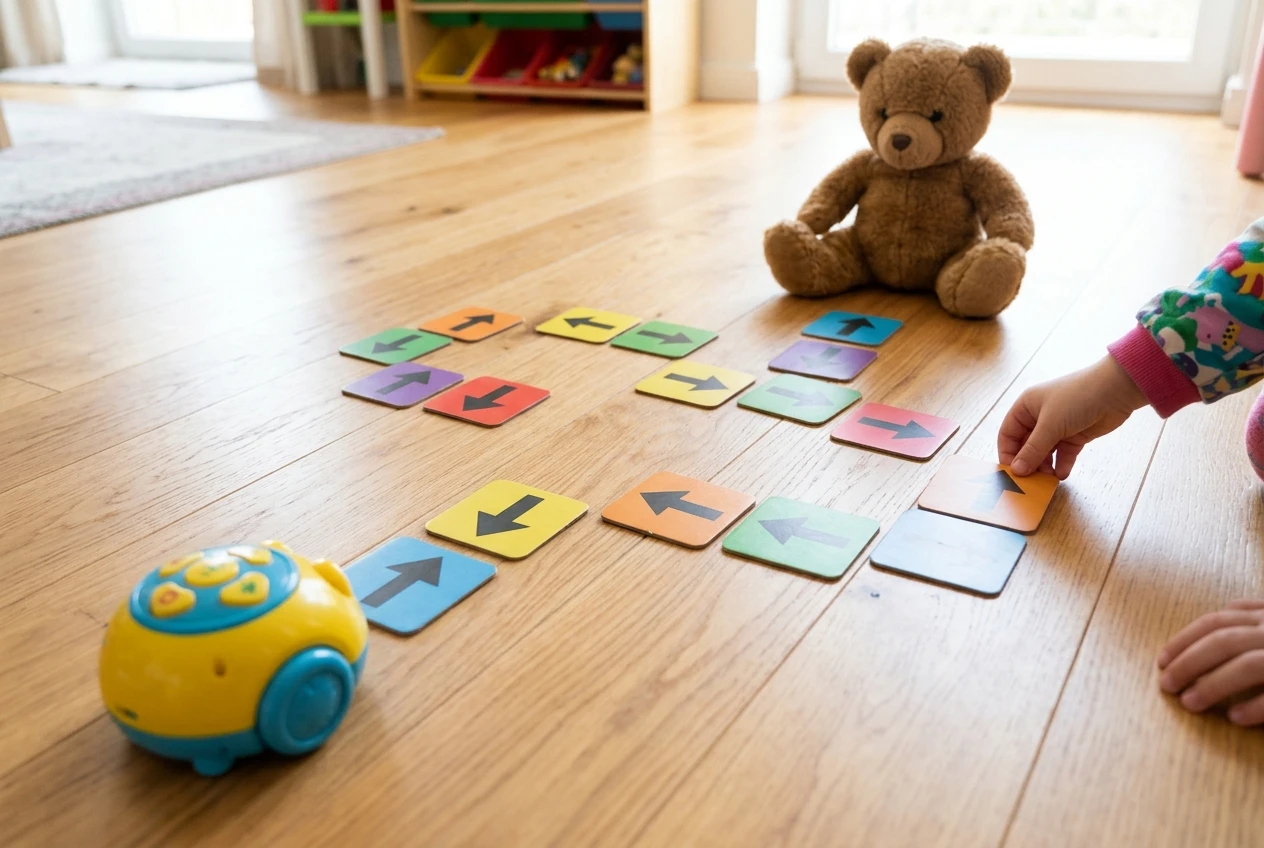
Low spend: sequencing cards and matching puzzles
Sequencing cards show three or four steps of an everyday event, such as planting a seed or making a sandwich, and ask the child to put them in order. Simple matching puzzles teach the same habit of looking for a rule and applying it. Both cost little and take almost no space.
You can also make a coding game at home. Put arrow cards on the floor and ask your child to “program” you to walk to a toy by laying the cards in order. It costs nothing and shows a child what a sequence of instructions does.
Middle spend: pattern puzzles and cooperative board games
Pattern puzzles ask a child to work out which piece fits a rule, not just which shape fits a gap. Cooperative board games, where players work together against the game instead of against each other, add turn-taking and shared planning. Pick a game with a short play time. A three-year-old’s attention for one game is brief.
Higher spend: a screen-free floor robot or path-building set
A screen-free floor robot, programmed with buttons or physical blocks, lets a child plan a route, run it and fix the mistake when the robot goes the wrong way. Debugging is the most valuable part: the child sees that a wrong result comes from a specific instruction, and changes that instruction.
Check that the set needs no tablet or phone to run, and that the instructions can be entered by a child of 4 or 5 without help. Our guide to coding toys for toddlers goes through screen-free logic toys in more detail, including options for younger children.
How much should you spend on a preschool STEM toy?
Spend the least on a toy your child has not tried yet, and the most on one they have already shown they will use repeatedly. A cheap version of a toy lets you find out whether a child likes building, measuring or sorting before you buy a larger set.
Here is a practical way to use the three tiers:
- Start in the low spend tier. Try boxes and tape, dice and cards, or a magnifying glass for a couple of weeks.
- Move to middle spend when a child returns to an activity unprompted. If they keep asking to build, count or look at things, a better set is worth buying.
- Choose higher spend only for proven favorites. A large set of blocks or a microscope pays off when a child uses it often and for longer each time.
Two things make a higher-priced toy better value. The first is a large piece count in open-ended sets: blocks and magnetic tiles stay interesting because the number of things you can build keeps growing. The second is durability: wooden and solid plastic pieces survive years of use and can be handed on to a younger sibling.
Be cautious about toys with a motor, lights or electronics. Those features raise the price, but a child often stops using the toy once the novelty fades, because the toy does the interesting part and the child only presses a button. Set this against a plain set of blocks, where every result comes from the child’s own decisions.
If a gift-giver is asking what to buy, a single mid-range open-ended set usually works better than several cheap novelty items, because the child gets a toy with enough pieces to be useful.
How do you know which pick suits your child?
Match the toy to what your child already does when they play, because a toy that fits an existing habit gets used and one that fits a goal you have for them often does not. Watch for a week before you buy.
- If your child stacks, lines up or builds things: go to the engineering picks.
- If they count stairs, sort snacks or arrange toys by color: go to the early math picks.
- If they collect leaves, ask why things happen or poke at puddles: go to the science picks.
- If they like puzzles, rules, routines and putting things in order: go to the logic picks.
Age also matters within the 3 to 5 range. A 3-year-old usually does best with large pieces and one-step tasks, such as a simple pattern with two colors or a short ramp. A 5-year-old can handle smaller pieces, longer sequences and some reading of simple cards.
Safety checks belong in every purchase. Read the age rating on the packaging, look for small parts if a younger sibling shares the toys, and keep magnets and button batteries out of reach of any child who still mouths objects.
If you want a method for judging any toy yourself, rather than a list of picks, read my guide on how to pick STEM toys for a preschooler, which explains how to tell a toy that will be used from one that will end up in the back of a cupboard.