Montessori toys for toddlers are simple, single-purpose objects that a child can pick up and use without an adult showing the way. A toy fits the approach when it does one clear thing and the child decides how to play with it. Batteries, lights and built-in songs usually work against both.
What makes a toy Montessori inspired for a toddler?
A toy is Montessori inspired when it has one clear purpose and the child leads the play. Maria Montessori was an Italian physician and educator who built her method around watching children and giving them materials they could handle on their own. Those two ideas, a single purpose and a child in charge, are what you are looking for when you shop.
The word “inspired” matters because “Montessori” on a toy box is a marketing choice. It does not guarantee that the toy follows the approach, and prices and packaging say nothing about it either. A plain set of wooden cups can fit the idea better than a pricey “Montessori learning center” with six activities bolted onto one frame.
Here is the test in two parts:
- One clear purpose: you can say what the toy is for in a single short sentence, such as “the rings go on the pole” or “the ball goes into the hole.”
- Child-led play: your toddler can start, repeat, change and stop the activity without you explaining it or the toy dictating the sequence.
If a toy passes both, it fits. If it fails either one, the label on the box does not change that.
Why does simplicity matter more than extra features?
Simplicity matters because a toddler learns from a toy that presents one problem at a time. When the problem is clear, the child can try it, see what happened and try again. That repetition is most of what toddler play looks like.
Take a ring stacker. The task is obvious: rings go on the pole. If a ring will not fit because it was placed out of order, the toy shows the child the mistake without a word from you. The child fixes it and learns from the result.
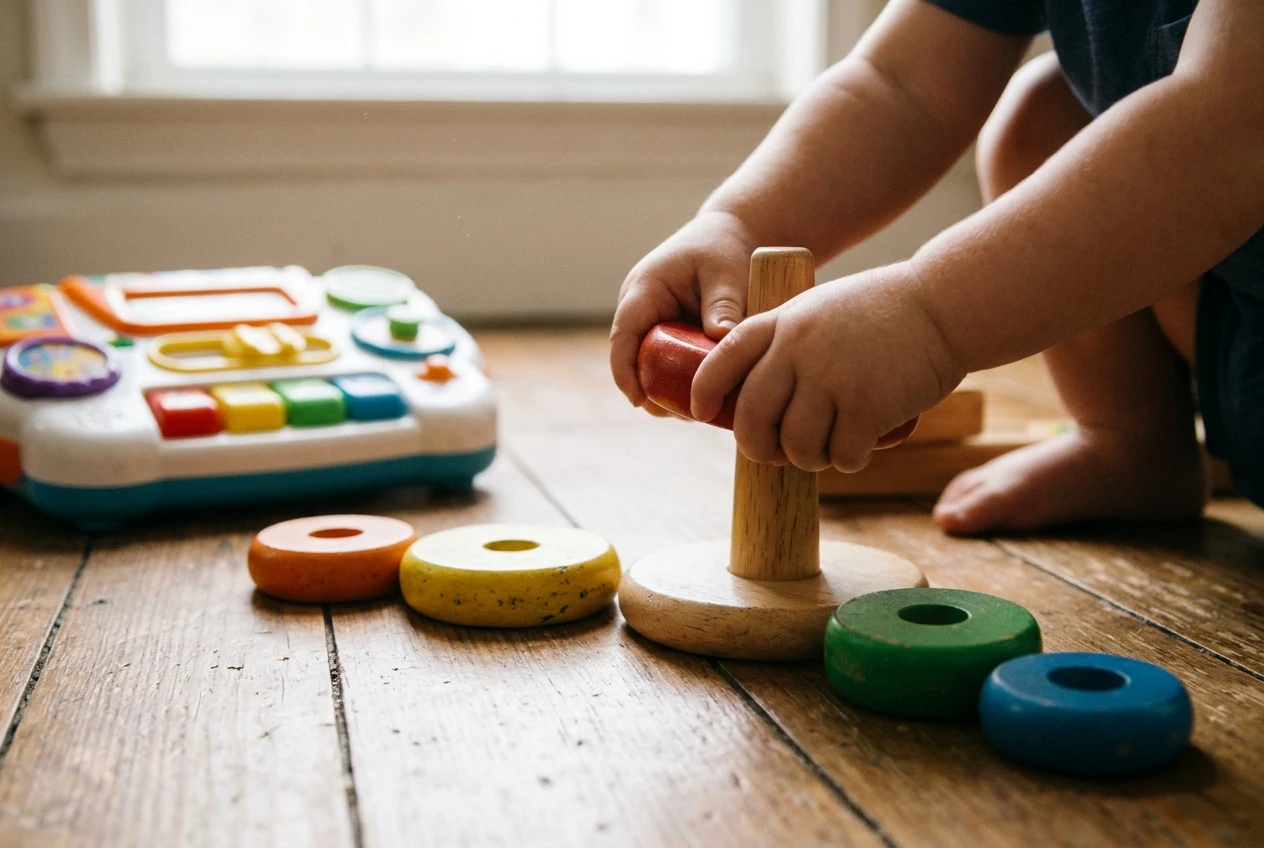
Now take a toy that lights up, plays a song and says the color when a button is pressed. The toy does the interesting part, and the child’s job shrinks to pressing. Once the novelty fades, there is little left to do with it.
Simple toys also have practical advantages:
- Fewer parts to lose, break or clean.
- More than one way to use them, since a plain block can become a tower, a road or a bridge.
- Less noise in the house, which helps a toddler concentrate on what their hands are doing.
Extra features are not always harmful, but each one takes a decision away from the child. Ask what a feature adds to the child’s play, and if the answer is “it entertains them,” the toy is entertaining them instead of the other way around.
How does child-led play change what you buy?
Child-led play changes what you buy because you choose for what your toddler can do now, not for what you hope they will learn. A toy that needs an adult to explain the rules, keep score or supply the next step is parent-led, however educational the box claims it is.
Three habits help when you shop this way:
- Buy for current ability. A toddler who is still learning to grasp a chunky knob will do better with a knobbed puzzle than with a puzzle of tiny pieces meant for an older child. A toy that is slightly too hard teaches frustration. One that is slightly too easy still gets used, because repetition is how toddlers practice.
- Look for toys that respond to the child’s actions. A ball dropped into a hole rolls out. A block placed on another block stays there or falls. The toy answers the child directly, with no battery involved.
- Choose toys that work without you. If your toddler can pick the toy off the shelf, use it and put it back while you are in the next room, it supports independent play.
Child-led play also means accepting that your toddler will use a toy in ways you did not plan. A child who carries stacking cups around in a basket instead of stacking them is still handling, filling and emptying. You do not need to correct it unless the use is unsafe.
How can you tell if a toy fits the approach before you buy it?
You can tell by asking four questions about the toy and checking its safety rating for your child’s age. The questions take about a minute and work on any toy, in a store or in an online listing.
- What is it for? If you cannot answer in one short sentence, the toy has too many jobs.
- What does the child do first? Picture your toddler alone with it. If the first move is pressing a button and watching, the toy is leading.
- Does the toy show mistakes? A shape that will not fit, a ring that leaves a gap or a tower that falls gives feedback without an adult.
- Can it be used more than one way? Open-ended use keeps a toy interesting for longer as the child grows.
Here is how the answers usually sort out:
Question | Usually fits | Usually does not fit |
|---|---|---|
Purpose | One clear task | Many “modes” or activities in one |
Who leads | Child chooses what to do | Toy plays sounds or sets the sequence |
Feedback | Child sees the result in the object | Lights or voice say “correct” |
Use | Works several ways | Works one scripted way |
Check safety separately. Toddlers put things in their mouths, so look at the age grading on the packaging and avoid anything with small parts for a child who still mouths objects. A common home check is whether a part fits inside a toilet paper tube, which marks it as a choking hazard. Read the maker’s guidance and follow it over any style preference.
Which kinds of toys suit toddlers best?
The toys that suit toddlers best are plain, sturdy objects they can grasp, fill, stack, sort or push. Most of them are inexpensive and many are made of wood, though material matters less than purpose. Here are the types that tend to pass the two-part test:
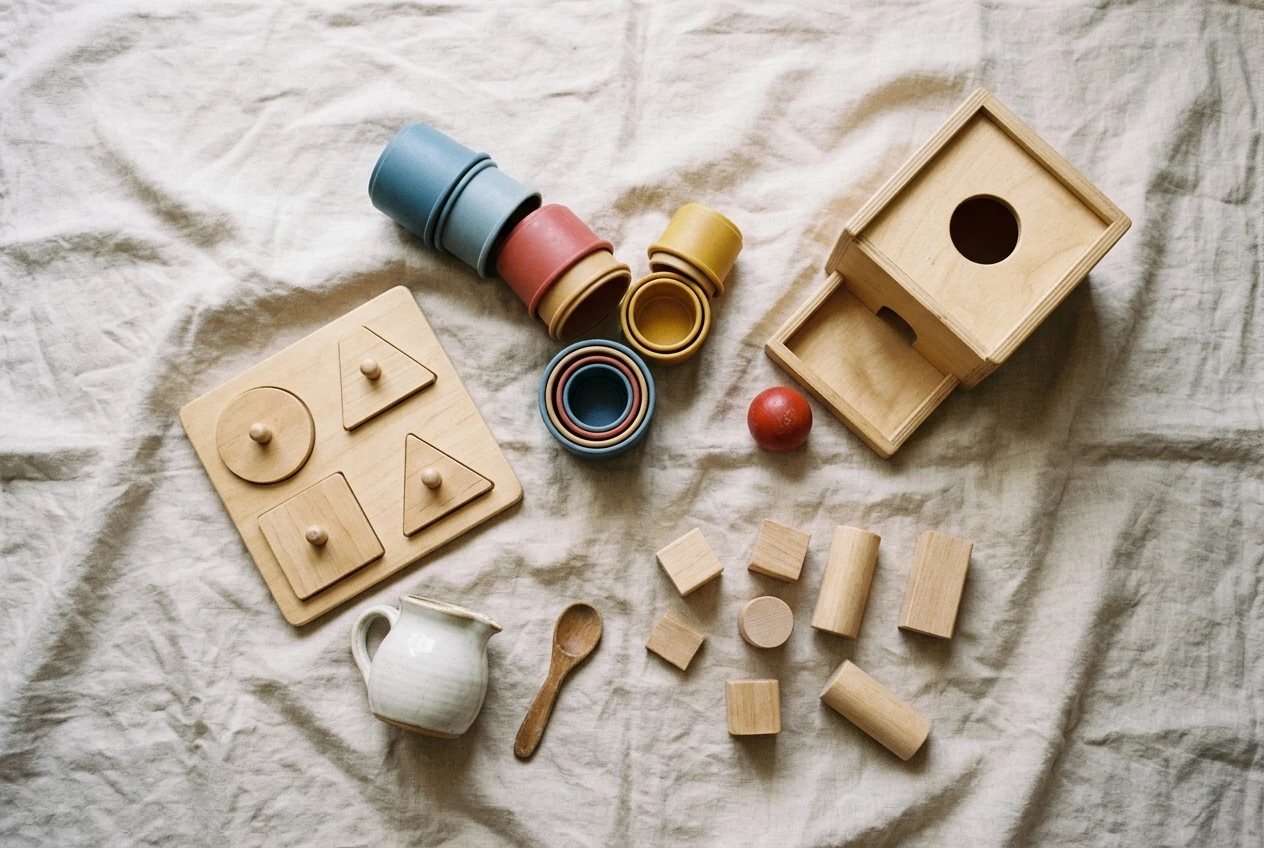
- Stacking and nesting toys: rings on a pole, nesting cups and chunky blocks. They teach size, order and balance through trial and error.
- Simple puzzles with knobs: a few large pieces, one shape per space, so the child can see when a piece belongs.
- Shape sorters with a small number of shapes: two or three shapes are enough to start.
- Ball drops and object permanence boxes: the object disappears and comes back out, which toddlers will repeat many times.
- Blocks: plain, same-sized blocks give the most room for the child’s own ideas.
- Real-life objects in toddler size: a small pitcher, a cloth, a basket or a wooden spoon. Everyday items often hold a toddler’s attention as well as anything sold as a toy.
- Board books: sturdy, with clear pictures, kept where the child can reach them.
For specific wooden options, our roundup of educational wooden learning toys for toddlers covers more choices. Use the four questions above to judge any of them against your own child.
How do you set up a toy shelf your toddler can run alone?
You set up a toddler-run toy shelf with a low open shelf, a small number of toys and a clear place for each one. The goal is for your child to see everything available, choose one thing, use it and return it without help.
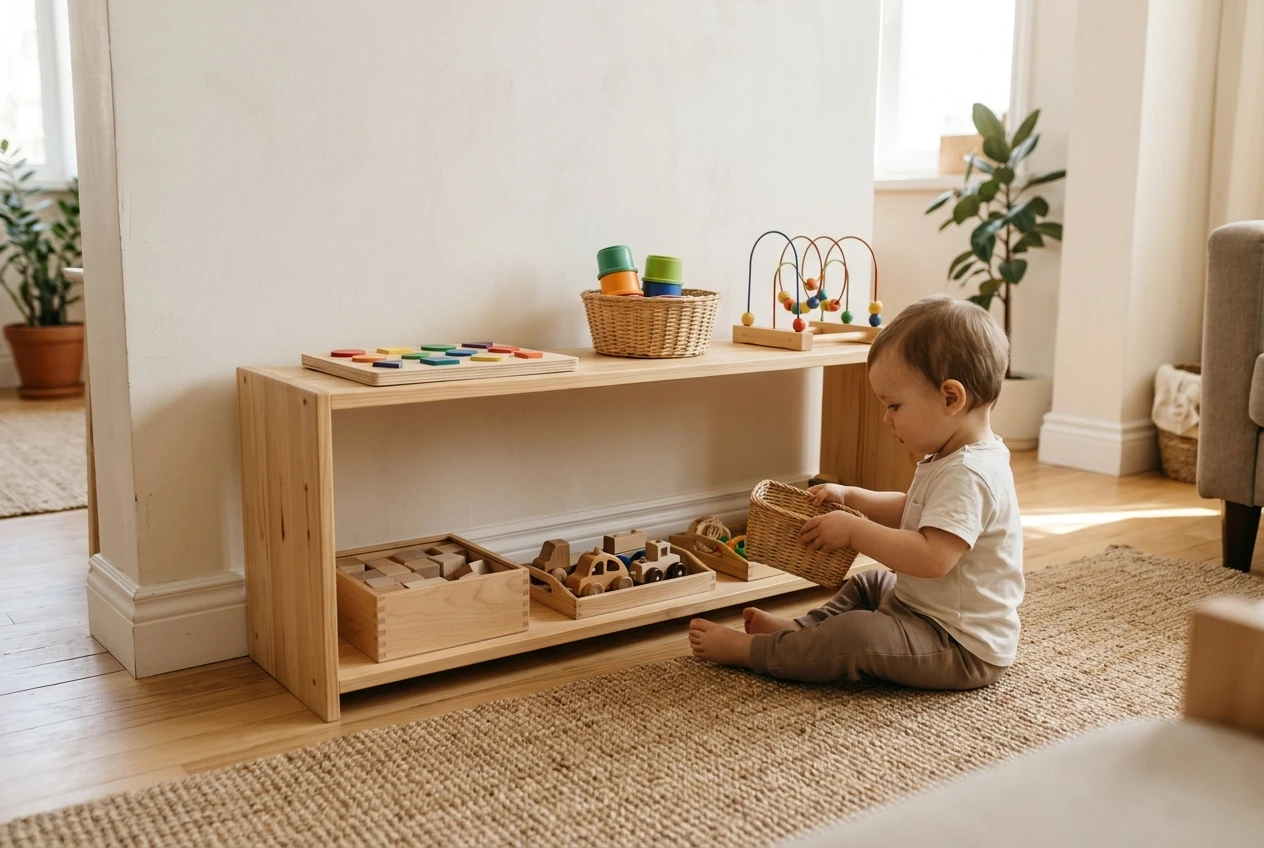
- Pick a low, open shelf. Your toddler should reach every item while standing or sitting. Closed bins and toy chests hide what is inside, so the child tips everything out to find one toy.
- Put out a handful of toys, around six to eight. A crowded shelf makes choosing harder and cleanup a chore. Store the rest out of sight.
- Give each toy its own spot. One toy per tray or basket works well. A puzzle sits on a tray, the cups sit in a basket, and the blocks sit in their own container.
- Keep sets together. A tray with a single activity tells the child what the toy is for and where the pieces belong.
- Show the cleanup once, slowly. Pick up a toy, use it for a moment, then return it to its spot while your toddler watches. Repeat on later days. Expect imperfect results for a while.
- Rotate every week or two. Swap a few toys for ones from storage when you notice your child ignoring something. Watching what gets used and what gets skipped tells you what to bring out next.
- Remove what is broken or unused. A cracked piece or a puzzle with missing parts frustrates a child who cannot fix it.
A shelf like this takes a few minutes to set up, and it gives your toddler a choice every time they go to play. That choice is the child-led part of the approach put into practice.
What should you skip, even when the box says Montessori?
Skip anything that fails the two-part test, whatever the packaging claims. Marketing language sells well, and plenty of toys use the Montessori name for their look rather than their design.
Watch for these:
- Electronic toys with lights, songs or voices. They lead the play and give feedback through sound instead of through the object.
- Toys with many activities on one frame. Several purposes in one toy means no clear purpose.
- Toys that only look the part. Natural wood and muted colors are a style. A wooden toy with five gimmicks still has five gimmicks.
- Sets with dozens of tiny pieces. They are a safety concern for toddlers and hard to keep organized on a shelf.
- Toys that need an adult to run them. If you have to supply the rules, the toy is not child-led.
- Anything chosen for the shelf photo. A shelf that looks good but holds toys your toddler cannot use alone has missed the point.
Price is not a reliable signal either. An expensive set can fail the test, and a simple, low-cost toy can pass it. Judge the toy by what it asks your child to do.
Ready to pick your first few toys? Start with our guide to the best stacking toys for toddlers, a good fit for a simple, child-led shelf.