Stacking toys build spatial awareness because every tower asks a child to judge size, position and balance with their hands before they can describe any of it in words.
Knocking down, lining up, stacking, bridging and balancing odd shapes each practice a different part of that skill, and a parent’s small nudges can strengthen it.
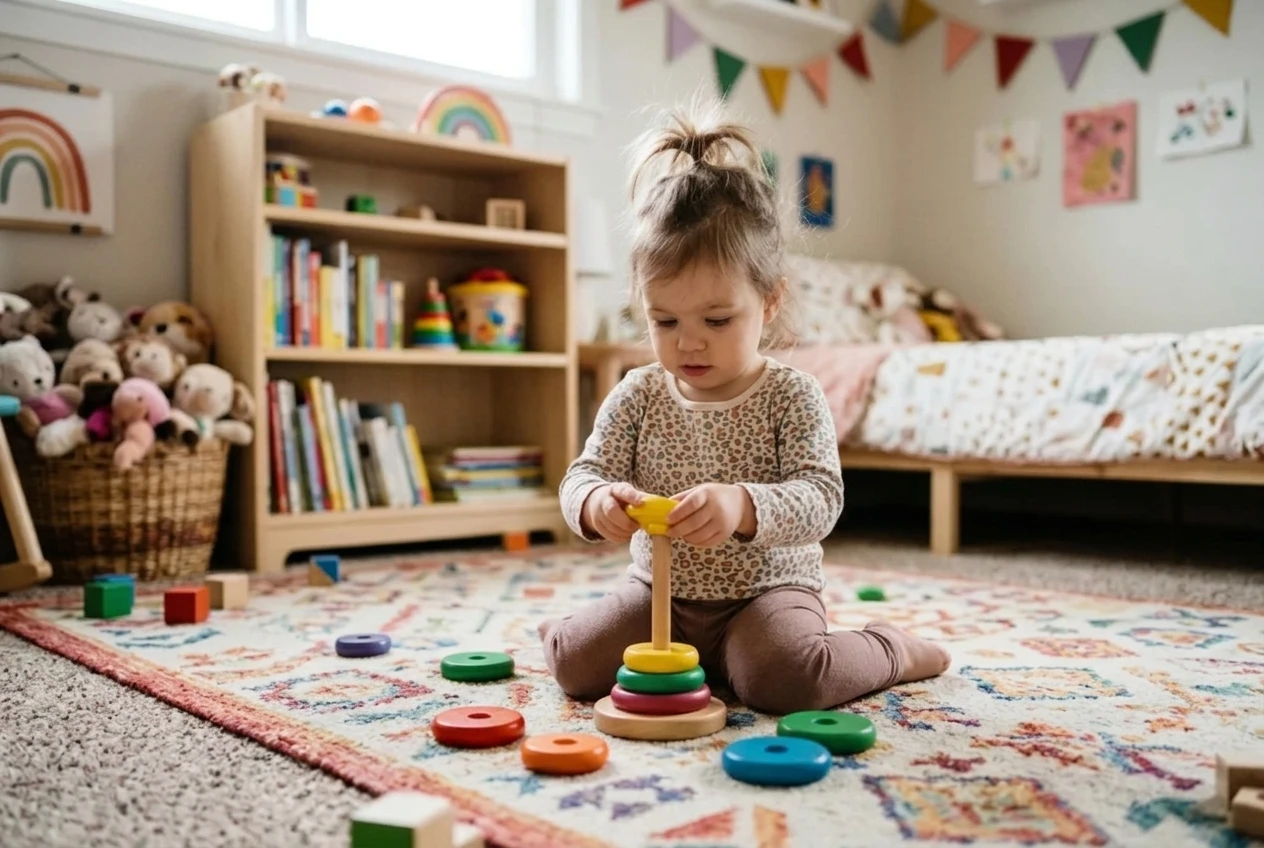
What is Spatial Awareness, and Why Does Stacking Train It?
Spatial awareness is the ability to understand where objects are, how big they are, and how they relate to each other and to your own body.
A child uses it to fit a puzzle piece into its slot, judge whether they can squeeze under a table, or work out which way a cup must tip to pour.
Stacking trains this because the toy gives instant, physical feedback. A block placed slightly off center wobbles. A block that is too small for the base looks wrong and sometimes falls.
A tower built too tall leans and drops. The child does not need to be told what went wrong, because the tower shows them.
Research published in the journal Cognitive Development in 2026 also found a relationship between children’s block-building abilities and their formal spatial skills, highlighting how building with blocks can provide opportunities to develop spatial thinking.
Several separate skills are practiced at once:
- Size and shape judgement: which block is bigger, which one fits on top of which.
- Position and direction: over, under, beside, next to, on top.
- Balance and weight: where a block must sit so it stays put.
- Hand and eye coordination: placing a block exactly where the eyes want it.
- Planning ahead: predicting what will happen before placing the next piece.
What does a child learn at each stage of stacking?
A child moves through several stages of block play, and each one practices something different. The ages below are rough guides, since children reach these points at different times and often return to earlier stages.
The National Association for the Education of Young Children (NAEYC) explains how block construction gives infants and toddlers opportunities to explore stacking, knocking down, spatial language, and early building skills.
Stage 1: Knocking things down
The first lesson is cause and effect. A child who swipes a tower is learning that their arm moves objects and that objects fall. This is early spatial learning, because the child is watching how things move through space. Knocking down is also a sign the child understands that someone built something worth knocking.
Stage 2: Carrying, dumping and lining up
Before blocks go on top of each other, many children fill containers, empty them and line blocks in a row. This practices ideas of in, out, full, empty, and next to. A line of blocks across the floor is a real spatial arrangement, even if it looks like a mess to an adult.
Stage 3: Stacking upright
Once a child can release a block gently, towers begin. The first towers are usually a few blocks high, and the child learns that each block must sit over the one below. Stacking rings and nesting cups work in this stage, because the child compares sizes to decide what goes where.
Stage 4: Bridges and enclosures
Building a bridge is a leap in spatial thinking. The child must understand a gap, find a block long enough to span it, and place it across two supports at the same height. Enclosures, such as a small fence around a toy animal, add the idea of inside and outside and the need to join corners.
Stage 5: Balancing uneven shapes
Cylinders, arches, triangles and half circles do not behave like cubes. A child has to feel where the weight sits and try different orientations. This is where children begin to predict, saying “that one will fall” before it does. Preschoolers often begin to build with a picture in mind, such as a house, a garage or a castle.
Which Stacking Toys Suit which Age and Skill Level?
The best stacking toy is the one that matches what the child is practicing now. Check the age label on any set, particularly for children who still put things in their mouths, since small pieces are a choking risk.
Health Canada recommends following manufacturers’ age guidelines and keeping toys with small parts away from children under three, as these can present choking hazards.
| Stage | What Suits It | What It Practices |
|---|---|---|
| Knocking Down and Early Stacking | Large, light blocks; soft blocks; simple stacking rings | Releasing objects, cause and effect, and size order |
| Lining Up and Early Towers | Nesting cups; chunky wooden cubes; shape sorters | Comparing sizes, in and out, and placing precisely |
| Bridges and Enclosures | Plain unit blocks in a few shapes, including long planks | Spanning gaps, matching heights, and joining corners |
| Balancing Uneven Shapes | Cylinders, arches, half circles, and wooden balancing sets | Weight and balance, planning, and picturing a design |
A smaller set of plain blocks usually gives more to work with than a large set of fancy pieces. Plain shapes can be a wall, a road or a bed for a doll, while a themed piece often only does one thing.
How Can You Guide Block Play Without Taking it Over?
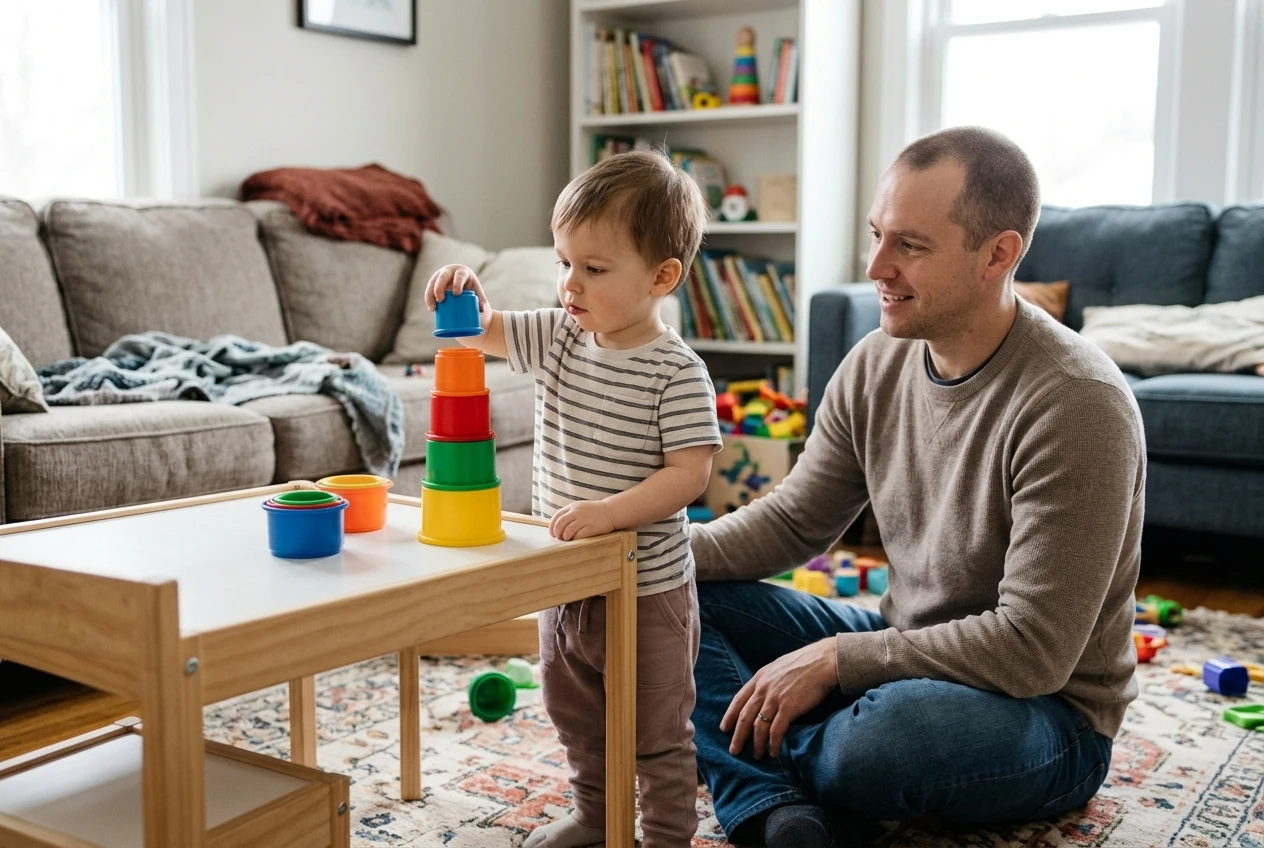
The most useful thing an adult can do is sit nearby, build alongside, and talk about what you see. If you build the tower for the child, you do the spatial thinking for them.
Playful interactions between adults and young children also provide opportunities to strengthen important developmental skills, including attention, working memory, and self-control, as explained by Harvard University’s Center on the Developing Child.
A few habits help:
- Describe, don’t direct. Say “that block is longer than the others” rather than “put the long one there.”
- Use position words. Over, under, between, next to, beside, and on top give the child words for what their hands already know.
- Ask open questions. “What could we put across the gap?” gives the child a problem to solve.
- Let it fall. A collapsing tower teaches more than a rescued one. Wait a moment before offering help.
- Build your own nearby. Make a simple structure next to theirs. The child may copy it, change it or ignore it, and all three are useful.
If a child gets frustrated, offer one small step, such as steadying the base, and then hand the task back.
What Simple Stacking Challenges Can you Try at Home this Week?
These challenges need only a basic set of blocks, or even household items such as small boxes and cups. Try them as games, and stop when interest fades.
- Biggest to smallest. Ask your child to stack nesting cups or rings in order of size, then mix them up and try again.
- Build a tower as tall as a toy. Choose a stuffed animal and see whether the tower can reach its height.
- Bridge for a car. Place two stacks a short distance apart and ask what could span the gap so a toy car can drive across.
- Copy my shape. Build a simple structure of three or four blocks and ask the child to make one that looks the same.
- A house with a roof. Offer a triangle or a flat plank and see how your child solves the problem of covering a space.
- Balance one odd piece. Give a cylinder or arch and ask where it can sit so it stays up.
For younger toddlers, only the first two or three are likely to suit. Save the others for when towers are no longer a challenge.
How Do you Know Your Child is Making Progress?
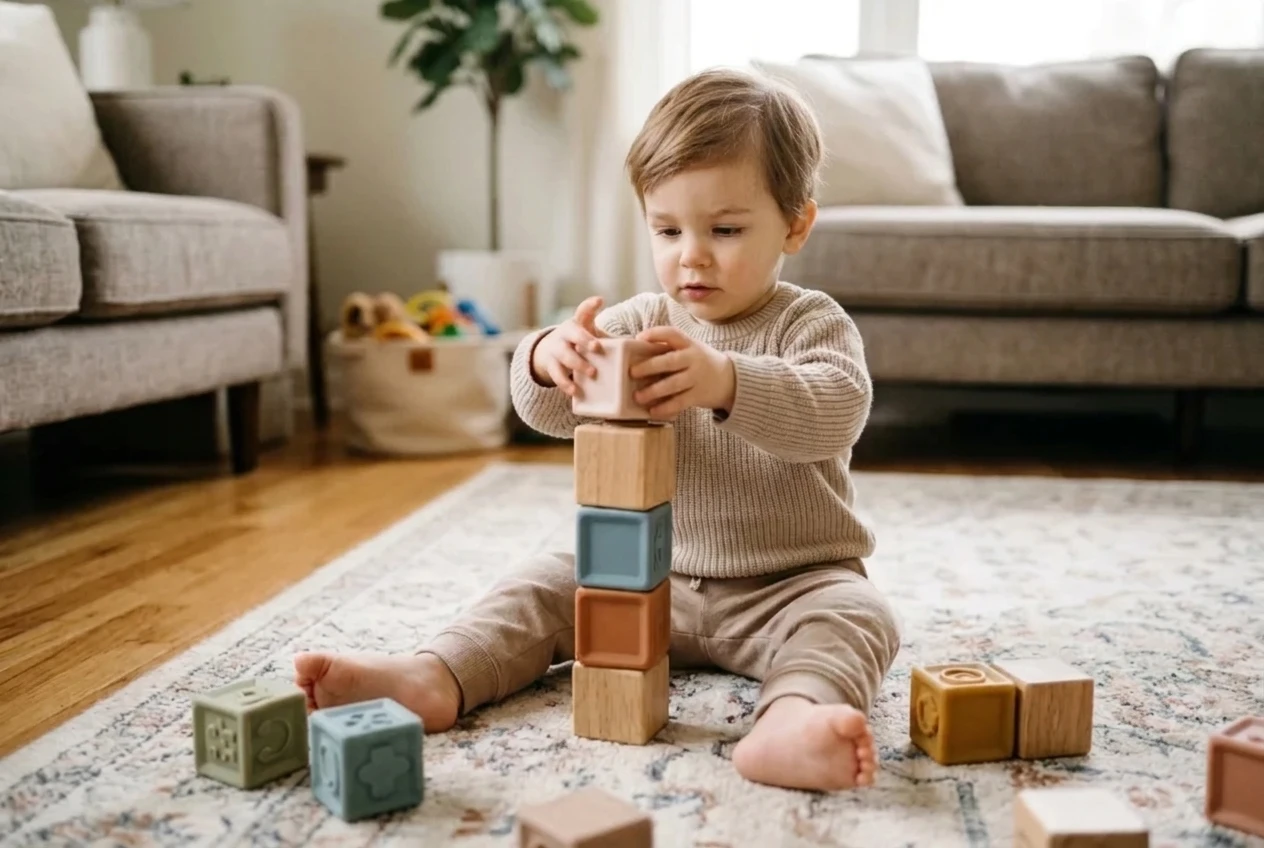
Progress in block play shows up in what the child does and says more than in how tall the tower is. Watch for changes like these:
- The child places blocks with less trial and error and fewer drops.
- Towers become taller or last longer before falling.
- The child chooses a block that fits the gap on the first or second try.
- Structures begin to have a purpose, such as a garage or a fence.
- The child uses position words, or points to explain where something goes.
- The child predicts a fall, or fixes a leaning tower before it drops.
- Play lasts longer and the child returns to the same build later.
A child who spends weeks lining up blocks is not stuck. They are working on something that will feed into later stacking, so there is no need to hurry them along.
When Should You Move on to More Complex Building Toys?
Move on when your child builds with the current set easily and starts to look for something it cannot do.
Signs include building the same tower over and over without interest, asking for more pieces, or trying to make shapes the blocks cannot make.
At that point, add variety before you add complexity. Introduce new shapes, such as arches and cylinders, or a few extra blocks of a different size.
Later, interlocking bricks, magnetic tiles and construction sets with connectors give children new ways to join and plan. Keep the old blocks available, because children often combine old and new sets in surprising ways.
If you are deciding what to buy next, the related post on picking STEM toys for a preschooler can help you choose your next building toy with confidence.